
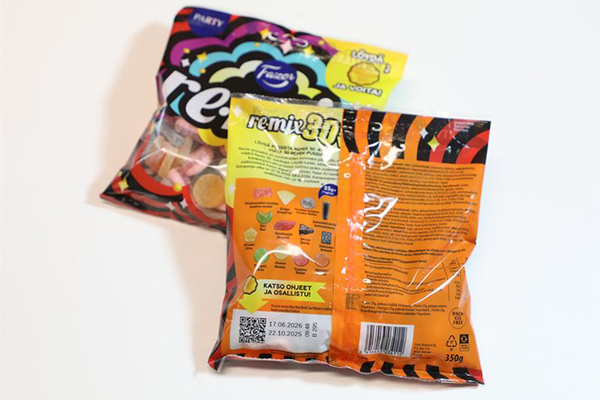
A pilot project is underway in Finland to test a new global labeling method, the GS1 2D code. This new code brings intelligence to consumer packaging and enables more effective use of product data. The pilot involves Fazer, S Group, KLINGER Finland, and GS1 Finland. The dynamic 2D code appears on Fazer Remix 30th anniversary packaging.
The importance of product data is rapidly increasing in the food industry. Regulation is raising requirements for traceability, consumers expect transparency, and companies are seeking ways to use data more efficiently across the entire supply chain.
The GS1 2D code is a QR code–like marking that may, in the long term, replace the traditional EAN barcode.
At the core of the code is a unique GTIN product number, which can be read at the checkout just like the current barcode. In addition, the code can include a link to consumer-facing web content as well as dynamic, batch-specific data for supply chain use, such as best-before dates or production batch information.
– The new code improves the flow of information between manufacturers and retailers and opens new opportunities, for example in waste management, says Katja Santala, Packaging Development Director at Fazer.
Traceability Requirements Highlight the Role of Data
For the food industry, this is not just about a new code on packaging, but about structuring data and enabling smoother data flows across the entire value chain.
Requirements for product traceability are increasing both at the EU level and in Finland. The dynamic 2D code offers one solution for making batch-specific information easily accessible to both retailers and consumers.
– Although we are still at an early stage of development, the pilot helps assess the concrete benefits that 2D barcodes can bring to the retail value chain and what process changes their future use will require, says Mikko Hänninen, Development Director of Grocery Trade at S Group.
According to GS1 Finland, standardization is key: when data moves in a compatible format, it can also be efficiently utilized internationally.
– When batch-level data flows through the supply chain, product safety and responsibility can be strengthened, for example by linking more detailed information about product origin, says Kimmo Keravuori of GS1 Finland.
Collaboration Enables Learning
For consumers, the GS1 2D code appears as a QR code that can be scanned with a smartphone camera. In the pilot, the code directs users to the Remix 30th anniversary campaign page, but in the future, it could be used to provide, for example, sustainability information, usage instructions, or an easy channel for consumer feedback.
A significant difference compared to traditional QR codes is that in this pilot, each package receives a batch-specific, dynamic code printed directly on the packaging line. The solution is implemented by KLINGER Finland together with its technology partner.
– We implemented a marking system where product labeling and automatic quality control are integrated. Camera monitoring ensures that no product leaves the line without the correct marking, says Jari-Pekka Eskelinen of KLINGER Finland.
The main goal of the pilot is learning what kind of data should be included in the code, how data moves between systems, and what investments the new labeling method requires. According to Fazer, such development is not possible alone.
– As a manufacturer, we need retail partners to understand how and where the new standard delivers real value in data sharing.