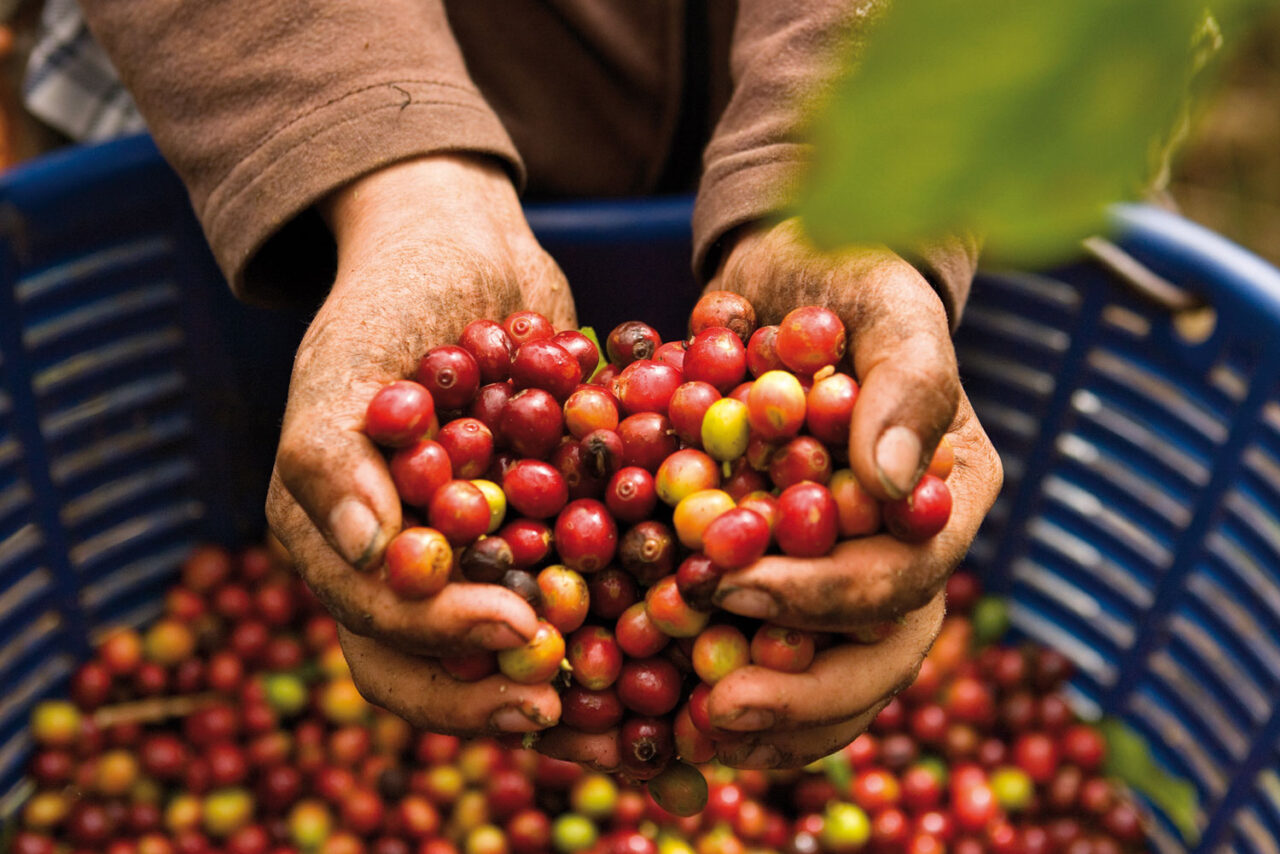
Cocoa and coffee provide an important source of livelihood for farmers and wellbeing for local communities. Fazer and Paulig work together with procurement partners and farmers to improve the profitability of cultivation, develop environmentally sustainable farming practices, and enhance quality of life.
Fazer purchases cocoa from grown in Nigeria, Côte d’Ivoire and Ecuador. Paulig, in turn, purchases green coffee from Brazil, Colombia, the nations of Central America, and several East African states. The most important country of origin for coffee is Brazil, which produces around one-third of all the world’s coffee.
Both cocoa and coffee are demanding crops. Cocoa requires a year-round tropical climate and plenty of right-timed rainfall. Rain at the wrong time can cause plant diseases or ruin the flowering process. Cocoa is also sensitive to intense sunlight and therefore needs shading vegetation.
Coffee, which grows on both sides of the equator, requires a balance of warmth and coolness. It is typically grown on mountain slopes where night-time temperatures drop low enough. As global warming continues, coffee cultivation must move to higher altitudes. It is estimated that up to half of the current coffee-growing areas may be at risk by 2050.
Local vitality and livelihoods for millions
Cocoa and coffee are vital sources of income for millions of people. Five million farmers make their living from cocoa, and as many as 25 million grow coffee. Both crops support many more people when the farmers’ families and others in the value chain are included.
In recent years, global market prices for green coffee and cocoa have risen significantly. Both Paulig’s Head of Sourcing, Anna Vänskä, and Fazer’s Procurement Director, Tuomas Linnavirta, have witnessed firsthand how price increases impact farmers.
“Higher prices encourage farmers to develop their production and skills. This also has a positive effect on the entire local community,” Vänskä says.
“As profitability has improved, farmers have been able to build better homes, and young people have returned from cities to rural areas. Cocoa farming has become a viable career option,” Linnavirta adds.
Profitability is crucial for the future of farming. Farmers are aging, and if farming does not provide a sustainable income, few will want to pass the profession on to their children.
Cocoa comes through Europe, coffee travels more directly
Fazer purchases cocoa butter, cocoa mass and cocoa powder from large manufacturers that source raw cocoa from thousands of farms. Buying directly from farmers would not be feasible, and in many countries, it is also forbidden for international companies.
All cocoa used by Fazer is sourced from responsibly managed origins. Procurement partners are carefully selected based on criteria such as responsibility, raw material quality, and risk management. Every actor and their production facilities undergo audits. Partners must provide transparency throughout the supply chain and commit to supporting farmers and local communities.
Coffee’s route to Finland is more direct, although it also relies on a vast network of smallholder farmers. In the country of origin, Paulig’s procurement partner collects batches that meet the company’s quality requirements. Paulig is responsible for shipping the green coffee by sea to Finland.
Since 2019, all coffee purchased by Paulig has been responsibly verified. The coffee is traceable and either certified (Rainforest Alliance or Fairtrade & organic) or produced under the partner’s responsibility program.
A third-party auditor monitors compliance with sourcing criteria for both companies. Companies also conduct their own audits and maintain close contact with partners to track and improve operations on the ground.
More profitable and responsible farming
Fazer believes that its farmer programs can improve not only productivity and environmental sustainability but also local wellbeing.
Key themes in Fazer’s programs include eliminating child labor, preventing deforestation, supporting farmers’ livelihoods, and reducing carbon emissions. For example, strict requirements apply to monitoring child labor, paying premiums to farmers, ensuring cocoa quality, and following proper farming practices. Procurement partners must verify compliance.
To improve profitability and support farmer communities, training and knowledge-sharing are provided. Cocoa yields can be increased through proper tree pruning. Environmentally important measures include the safe use of agrochemicals, waste management and natural pest control methods. Farmers are also guided to use leaves and shells as fertilizer and to remove “mummified” fruits to prevent disease spread.
“In Nigeria, we have worked with farmers for ten years. It has been great to hear that yields have doubled thanks to good farming practices,” Linnavirta says.
As EU regulations and responsibility requirements tighten, certificates alone are no longer sufficient — impacts must be demonstrated with data. Fazer sees its own programs help to monitor progress more accurately and direct support where it is most needed.
In past decades, cocoa cultivation was a major driver of deforestation. When grown correctly, cocoa can even support biodiversity, as it thrives in forested environments with rich plant life.

Climate-smarter farming through collaboration
Paulig also develops coffee cultivation through its partnership programs. Key themes include reducing carbon emissions, preserving biodiversity, protecting waterways, and preventing deforestation.
About one-third of Paulig’s coffee comes through partnership programs, with the rest sourced via third-party certifications. The responsibility requirements are similar in both cases, but Paulig’s own programs allow for tailored local projects and deeper support for farmers.
Since around 70% of coffee’s carbon footprint is generated in the farming stage, environmental impact can best be reduced through collaboration with farmers. New, sustainable farming practices are promoted through model farms.
“Long-term work is needed — farm visits, training and time for practices to spread from one farm to another,” Vänskä says.
For five years, Paulig has implemented projects to advance regenerative farming practices and reduce greenhouse gas emissions. Often, the same measures improve coffee quality and farm profitability.
“In one project, sugarcane and legumes were planted between coffee bushes. These plants fix nitrogen and carbon from the air, improve soil health, retain moisture and support biodiversity. At the same time, they reduce the need for fertilizers and create natural ground cover for the coffee plants,” Vänskä says.
Health, education and clean water
Both companies also focus on improving wellbeing and living conditions in sourcing regions. Fazer has supported education and healthcare and arranged health check-ups for farmers.
“In 2024, we donated nine new wells. A single well can benefit thousands of people who previously had no access to clean drinking water,” Linnavirta says.
Paulig has helped renovate schools and improved learning environments and education quality.
“Improved school environments make education an appealing option in areas where parents might not otherwise send their children to school,” Vänskä notes.
Fazer also supports women’s rights and family livelihoods through projects that teach alternative income sources such as growing useful plants or producing soap.
Preventing child labor as part of responsible sourcing
Responsibility criteria prohibit child labor, but the risk still exists. Farms are often small family operations where children naturally help with work. This makes it essential to raise awareness of what work is appropriate for children. They may help with light tasks for a limited number of hours. However, work involving sharp tools, long days, heavy labor or night work is strictly prohibited. Work must also not interfere with schooling.
Fazer supports children’s education by monitoring child labor risks and providing school kits to help children begin their schooling.
Traceability is the starting point for responsible production
A major challenge in tracing cocoa and coffee is the huge number of small farms.
Fazer knows the regions and farming communities from which its cocoa originates, but tracing cocoa back to individual farms is usually not possible. Cocoa is collected from many small farms, transported in large batches to ports and shipped to Europe for processing. During this process, lots are mixed.
The smallest amount of coffee that arrives at Paulig is a full shipping container. A container may contain coffee from one farm or thousands of small farms. The origin can be traced at least to the farming community and often to individual farms.
“Traceability is the starting point for responsible production. To know how coffee was produced, we must know where it was produced,” Vänskä emphasizes.
Farmers also value knowing where their products end up. This motivates them to improve their practices, which enhances productivity and livelihoods. Traceability also ensures that the economic benefits of farming reach their intended recipients.
The EU’s new deforestation regulation will require full traceability for cocoa and coffee to ensure that their cultivation has not caused deforestation. The regulation will also help ensure that data is collected in a uniform format, making reporting and monitoring responsibility easier.
Pictures: Paulig